Tuesday, January 21, 2014

Induced Pluripotent Stem Cells

     Induced Pluripotent Stem Cells (iPSCs) are stem cells that can be reprogrammed from adult cells, often skin cells. In most cases, skin cells are taken from an adult and reprogrammed using specific genes, four known ones being Oct4, Sox2, Klf4, and c-Myc. These genes, which are active only in embryos, are able to reprogram adult cells back into embyotic cells. At this state, the cell can become any of the 220 human body cells.

     Most of the testing done has been on mice. Scientist have been able to correct mutations, if they know where the mutation is located. They have been able to kill some diseases in mice that mimic human diseases.


     Scientist have been able to deliver these reprogramming genes through adenviruses, which only last for a short amount of time, but leave the genes permanently. Scientist have also been successful in tricking adult cells to reprogram using chemicals that mimic the reprogramming cells. Soon, scientist hope to make drugs that can reprogram instead of using viruses.


     At this point in time, there are too many risks, such growing a teratoma in the brain (a teratoma is a type of tumor formed from embryonic cells when something is injected under the skin), for scientist to experiment on humans. And there are many people who believe that playing the role of God is wrong, and who will never permit human testing.

The Island

     In our last class, we watched the first half of The Island. The movie deals with the morals of creating clones, and using the clones' organs as transplant organs for patients.


     In the movie, the clones are made for one purpose, and that is to supply organs for high paying patients. Once the desired organ is removed from the clone, they are killed (if not already killed from the process of removing the organ).


     The clones are forced to eat foods that better their health, as well as exercises often, in order to make sure that the organs are in best health. Additionally, they are stuck inside all day, and are told lies that keep them from questioning anything. They are also put to work, though it is unclear what there job is (they insert stuff into pipes or something like that).


     Is it fair to make clones for our own sake? That has been a question for many people. Very soon, people will have to make the choice whether it is ethical to make clones for our own profit, or to make an army of something like that.

Saturday, January 11, 2014

Thyroid Cancer

For my research/review paper, I am focusing on thyroid cancer. Thyroid cancer is located in the thyroid gland at the front of your neck.


The Thyroid gland is often fully removed through surgery, removing the cancer along with it. This common procedure is called a thyroidectomy.


After the thyroid gland is removed through surgery, many patients are given radioactive iodine. Since the thyroid gland absorbs iodine, it absorbs the radioactive iodine. The radioactive iodine then kills any remaining thyroid cells, and hopefully all of the remaining cancer. Radioactive iodine can be used by itself, without a prior surgery, however it is not as common.


In our first week back we learned about cancer, and how telomeres allow cancer cells to continue through the cell cycle without a Hayflick limit. We learned that a normal growing cell is called a    proto-oncogene, and cell that divides uncontrollably is called an oncogene, and is cancerous. We also learned about tumor suppressor genes, and how they are affected by mutation.


Thursday, December 12, 2013

Chaper 6 Your Inner Fish & Embryology

Embyology

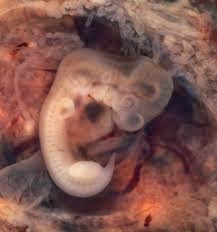
I learned that we are made of 2 trillion cells, but come from one. That one cell forms when the genetic material from the dad's sperm and the mom's egg fuse. Then the cell divides four times and forms 16 cells, which make up a blastocyst. The blastocyst implants into the mother's urethra and the embryo starts to develop. It joins the bloodstream of the mother.


They all look so similar. Different species.


Fertilization of an egg by a sperm, and formation of a blastocyst, which has 16 cells. They all clump together and stay on one side.


The three germ layers are Endoderm (inner), Ectoderm (outer), and Mesoderm (middle).


The Endoderm makes up the inner structures such as the digestive tract and glands. The Ectoderm forms the skin and the nervous system. The Mesoderm forms tissue between gut and skin, such as muscle.

This comes after the blastocyst, and it is known as a tube within a tube structure.


Another tube within a tube picture.


Human Embryo that forms.


These are called the Homeobox genes, and a fly has eight. They are mutated genes that can cause the fly to have extra wings, have a leg on its head, or miss a part of its body.


The DNA control is called the Organizer, and it determines the body plan. I think it is a chemical or something. All species have an organizer.

Sunday, December 8, 2013

Unit 4 Test & Unit 5 Project

Last Biology class, on Thursday, I took the Unit 4 Genetics Test. I was pretty nervous before the test because I had spent most of my time working on my Marfan Syndrome prezi and not a whole lot of time studying. However, I a relief when taking the test, because I knew everything on it pretty well. I feel that I probably missed one of the Hardy Weinberg problems. Mr. Weinberg was an evil man. Also, I was unsure about the question with the shark. Other than that, I felt pretty good when taking the test, and felt even better when I saw that I got all 1s on the standards.

As for the Unit 5 project, I have not started it yet. However, I have looked at some pictures of prokaryotic cells (which would be bacteria) and eukaryotic cells (which may be either plant or animal). I have learned only a couple of the organelles, but that is at least a start.


Prokaryotic


Eukaryotic


Similarities and Differences


Marfan Syndrome

For my Unit 4 Project I did Marfan Syndrome. It is a disease that causes a variety of different health problems. People with Marfan always appear to be slender and tall. This is an autosomal dominant trait, and is caused by a mutation of the FBN1 gene. Below I have some pictures of people who have been diagnosed with Marfan Syndrome. If you want to see more, particularly how it relates to our genetics chapter, click on this link to my prezi. http://prezi.com/udoguolukqrr/?utm_campaign=share&utm_medium=copy.


Special Genetics & Pedigrees

In the class before our test, we reviewed some types of special genetics, and we learned about a pedigree. The special genetics that we learned included Codominance, Incomplete Dominiance, and X-linked.

Codominance


Both colors are shown in the F1 generation. Not just one color, and not a mix of the colors. This is because both the gene for red color and the gene for white color are dominant.


People with type AB blood are dominant for both A and B.


The fish shows both colors.


So does the cow.


Incomplete Dominance


The F1 generation is a mix between the two parents. Red x White = Pink. 


Color dominance is incomplete.


White Dog x Brown Dog = Gold Dog


X-linked


Gene is attached to chromosome. Men cannot be heterozygous, the gene is not present on the Y chromosome. Women can be carriers, so have a slimmer chance of actually showing the recessive trait.


Pedigree


Shows the family tree for the trait. Can be a X-linked trait or autosomal. Don't be tricked by Mr. Quick into drawing one of these for no reason. He is sneaky!