Thursday, October 10, 2013

Parents Day

     Our homework before parents day was to read three articles all dealing with attractiveness. There was Averageness, Masculinity, and Symmetry.

     We learned that the more average a face is, the more attractive it is. This is because it is easiest to process, and is closest to the faces that we visualize in our mind. Curiously, when the features of the faces were exaggerated, the face was deemed the most attractive, somewhat disproving that the most average is the most attractive.

The Average is More Attractive


     We learned that both men and women typically find feminine facial features in the opposite sex to be more attractive. However, a female will find a more masculine face to be more attractive when seeking offspring.

Masculine Features vs. Feminine Features


     We also learned that the more symmetric the face is, the more attractive it appears to us, for it is the easiest to process. This is also true for objects.

Symmetrical Is Most Attractive


What Makes A Face Attractive

Both my parents and I found feminine facial features to be more attractive in both male and female faces. Feminine facial features are associated with a more caring and parenting person.


Brine Shrimp Lab Continued

   
     On Thursday, October 3rd, we finished up our Brine Shrimp lab. After collecting our final data and calculating the percent survival rates in the different salt-concentrated water, Brian and I calculated that the 0.5% salt-concentrated water had the highest survival rate. This would suggest that the majority of Brine Shrimp are adapted to survive in bodies of water similar to this example.


After finishing this lab, we did another lab, which showed how the animals that were not naturally selected to survive would die out. This could be caused by a gene that changes the animals appearance or features. For example, tigers that genetically have thin fur will die out in cold weather, will tigers with thick fur will survive. We represented this process by using two different colored beads.

We took the last moments of class taking a quiz on mutations, hereditary traits, ect.

Brine Shrimp Lab

Class Day 13

     On Tuesday, October 1st, we started a three day lab. This lab continued into office hours of the next day, and ended during our class on Thursday, October 3rd. Our goal was to find the affect of the concentration of salt in the water on the lives of Brine Shrimp. My prediction is that the Brine Shrimp need at least some salt to survive, for they are found in the ocean. However, I also predict that if the salt concentration is too high, the Brine Shrimp will die. What we must do is set up five different concentrations of salt in water, and recorded how many Brine Shrimp survive, and how many die or fail to hatch. I guess the water with either 1% or 1.5% salt will contain the highest percent of surviving Brine Shrimp.


     We tried to get about 20 eggs into each dish of water, but some of the dishes ended up with twice this amount. But since we recorded how many there were in each one, we should be fine.

Close Up Of Brine Shrimp Eggs

     When we showed back up on Wednesday during office hours, a few of the eggs had already hatched. At this time, the most amount of hatched eggs was found in the 0.5% salt concentrated water. This may suggest that Brine Shrimp live in bodies of water with salt concentrations similar to this.

Hatched Eggs

    The fact that there existed hatched eggs in different bodies of water prove that there were mutations that occurred that allowed some Brine Shrimp to live in higher salt-concentrated water, and some to live in lower salt-concentrated water.

At this point, our data also showed that no Brine Shrimp were able to survive in pure water.


Paleo Project Day

     During our class on Thursday, September 26th, we took a quiz on variables. It was extremely easy, and I got a perfect score on it. We learned a little bit more about the evidence of evolution, and about mutations and stuff. The remaining part of the class, we got to spend some time working on our Paleo Project, and planning out how we will divide the work and stuff like that.

Brian and I chose to research Miacoid, which is an early carnivore. According to what we found, Miacoid looks something like this...


For homework, we just had to watch a video and read a powerpoint on evidence for evolution, work on our Paleo Project, and work on our objective sheet if we wanted to.

Thursday, September 26, 2013

Common Ancestors Lab & Quiz


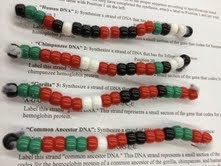
     In class on Tuesday, we paired up into groups and did a lab. We had the option between two labs, both dealing with common ancestry. Brian and I chose to do the lab that involved the creation of DNA strands with the use of different colored beads and a pipe cleaner. We made 4 in total, one being human, one chimpanzee, one gorilla, and one the common ancestor. We found that the chimpanzee and the human were the most closely related, and that all four species shared some common bases, so they all shared the same common ancestor. We clarified that the more similar the genes and DNA of the species, the more similar they are alike in nearly all features.

In order from top down, here are small sections of the gene that codes for the hemoglobin proteins of Humans, Chimpanzee, Gorilla, and Common Ancestor


Quiz Time

Part of our homework for tonight was to take a quiz on our blog, 
     so here goes my best attempt.


My Answers


1. The above picture shows morphological features shared between a common ancestor and its            
    descendants. There are homologous traits that can be found between all four of these species, 
    such as a similarity in arm structure. They all share the one bone, two bone, lots of bones      
    feature. When looking from the Mesonychid, to the Ambulocetus, to the Rodhocetus, to the 
    Basilosaurus, it can be seen that features such as the back legs did not appear and disappear 
    randomly, but rather gradually morphed over time, ending with the small flippers 
    at the base of the tail of the Basilosaurus.

2. e. North America

3. A dragonfly, a bird, and a bat all developed wings not as a result of homology, but rather 
    through convergent evolution. These shared traits are analogous, in that they formed as a 
    result of their environment, and did not originate from a common ancestor. Though they all 
    have wings, neither is quite similar to the other. A dragonfly has two wings on each side, a   
    bird has feathers on their wings, and a bat has a bone structure in their wings that is more 
    similar to that of a human arm. These three species gained their wings separately, as simple 
    adaptations to survive their environment. There is no direct link between any of them, they 
    did not evolve from each other.

4. In the Common Ancestor Lab, we created four different strands that each represented a small 
    section of the gene that codes for hemoglobin protein. Each hemoglobin strand represented a 
    different animal. We made one strand for a human, one for a chimpanzee, one for a gorilla, 
    and one for their common ancestor. The human and chimpanzee strands were the closest in 
    comparison, which explains why they appear to be very similar in structure, intelligence, and 
    more. With the common ancestor having the least similar DNA to humans, the 
    chimpanzee having the closest, and the gorilla somewhere in the middle, it can be concluded 
    that evolution exists, and that humans evolved from their common ancestor. While some of 
    the DNA experiences no change, other parts of the DNA change, leading to the formation of 
    a new species. This new formed species then experiences changes in its own DNA, and 
    forms yet another new species. DNA proves evolution, because similar DNA structures must 
    have originated from somewhere, and that somewhere is the common ancestor.

5. Homology is the study of the structural similarities or gene similarities between two or more 
    species, caused as the result of sharing a common ancestor. These similar features, otherwise 
    known as homologous features, are similar because they are inherited from a common 
    ancestor. These homologous features simply morph from this ancestor, they do not become 
    something entirely different. For example, the hand of a human and the hand of an ape are 
    said to be homologous, for they both inherited the characteristics of the hand of their common 
    ancestor. They cannot just change into wings over night. It would take millions and millions 
    of years for something like that to occur. In Your Inner Fish, an excellent example that shows 
    homology would be the one bone, then two bones, then blob of bones, then fingers structure 
    of the arm, as discovered by Sir Richard Owen. This structure can be seen in humans, seals, 
    lizards, birds, bats, penguins, and whales, among many other species. These similarities in 
    structure are no coincidence, but rather they all originated from a common ancestor with this 
    trait. It seems that this common ancestor was Tiktaalik, for it served as the transition species 
    from water to land, and was the first known species to have an arm such as this. Essentially, 
    all of the above species developed there arms similar to that of Tiktaalik, and therefore they 
    all share this homologous trait.


For homework, we also had to read Survival of the Sickest, chapter 4, and come up with a way to summarize it. I decided to do a poem. I added this poem below.

The buzzing sound of a million deaths,
was stopped at the site of a bean!
With the lack of an enzyme, the loss of red blood cells,
the blood would become too lean!

The tiny little beast, and G6PD deficiency,
two terrible diseases, many lives they have stole!
But together it’s true, throughout human evolution,
that this mutation has saved many souls!

Favism is so prevalent, and Pythagoras was right,
Eating fava beans was making his students sluggish!
Primaquine was the key, to the discovery of this disease,
in the Korean War where many soldiers perished!

But little did we know, that survival of the sickest
would lead to convergent evolution!
Favism would prevail, protection from malaria,
It was an illness that became part of the solution!


Monday, September 23, 2013

Fossil Day

     We started out the class by receiving our tests back. I did a lot better than what I was expecting. We then reviewed all of the multiple choice to make sure that everyone understood what they did wrong. Other than a few clumsy mistakes, I pretty much knew everything. I just need to make sure that I pay more attention to every detail of the question and the answers, and not just see that the first part of the answer sounds right, and move on without reading the rest of the answer thoroughly.

     The rest of the class we talked about the subjects that chapter 1, 2, and 11 of Your Inner Fish covered. We learned about how plate tectonics affects where a fossil will be found. For example, the fossil of a fish that might have existed in a tropical area near the equator may be found in places as far as the Arctic, because the plates might have shifted dramatically since that animal died.

Plate Tectonics

     We learned about how Tiktaalik adapted to better suit its environment, and how its changes included having a neck, a wrist and arm that allowed to do push-ups, a flat head, eyes on the top of its head, an expanded ribcage, and many more adaptations. This adaptions allowed it to survive by helping it protect itself, and hunt its prey better.

Tiktaalik Adapted To Survive


     We learned that the sequence of a wrist is similar in many different animals, due to the fact that they have common ancestors that held this trait.


We reviewed the basic idea that the older rocks are on the bottom, and the newer rocks are on the top.


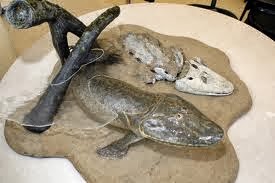
At the end of class, we took a little trip over to the Alf Museum, and took a look at Tiktaalik. We discussed his features in the museum, then came back to the classroom and discussed them some more.


Test Day

     Tuesday was our test day, and it went well. I only missed three multiple choice questions, and I got a perfect score on my graph and writing part. I was a little concerned that my writing section would be confusing to read, but I guess it was better that I had thought. Luckily, I did the Diffusion and Osmosis Lab, so i was exposed to this kind of problem already. Im glad to say that I did very well, despite only getting 2 hours of sleep the night before. The questions that I missed are quite clear to me now. They were mostly errors in interpreting the questions and paying attention to the little details. The biggest thing I learned out of this situation is that I should finish the entire lab report on the weekend, so that I can study and get some sleep before the test.


Get Sleep


Funny Joke


     Our homework for the class after the test was to read Chapters 1, 2, and 11 of Your Inner Fish. When reading this book, I found Neil Shubin's journey to be very interesting. Even though Shubin  failed time and time again to find the fossil of the species that started the transition from water to land, he and his crew were persistent and never gave up. It was after years and years of searching at a site on Ellesmere Island in Canada that they finally found Tiktaalik.

     The first chapter taught us about the process in which remains of an animal go through in order to become a fossil. We learned that a fossil is formed when it is covered by sediment, and compressed into the ground. The soft tissues of the bones are replaced by rock, in a process known as mineralization. Some of these fossils move do to shifts in the plates, and a lucky few are discovered by paleontologists. We also learned that it is best to search in an area where the rock is the same age as the desired fossil, and to search for fossils that are disposed.

     In the second chapter, we learned that creatures as different as humans and frogs share an arm bone scheme, starting at the shoulder, with one bone, two bones, lotsa bones, then fingers or toes. This discovery was made by Sir Richard Owen. This discovery shows the presence of homology, for these creatures received these traits from a common ancestor. If these creatures all developed these same traits, but did not receive them from a common ancestor, then they would be analogous to each other. Convergent evolution is what causes two animals to develop a similar trait without receiving the trait from a common ancestor.


Tiktaalik