Color’s Effect on a Roly-Poly’s Choice of Shelter
ABSTRACT: In this lab, our goal was to find out whether or not the colors of rocks
have an effect on a roly-poly’s decision of where to find shelter. For our
experiment, we placed 12 roly-polies in a choice chamber, which can be
described as two petri dishes with an area of crossover (pictured below). We filled one side of the choice chamber with
green rocks, and the other side with clear rocks. The green rocks were rigid
while the clear rocks were smooth and spherical. At the start of the
experiment, we placed 6 roly-polies on each side of the choice chamber and put
on a cover. Then at 30-second intervals, we took off the cover, recorded the
new numbers, and recovered the chamber. After 5 minutes of testing, our
experiment was concluded. Our final results showed that the number of
roly-polies on the side with green rocks had increased to 8, and the number of
roly-polies on the side with clear rocks had decreased to 4.
 |
| http://www.enasco.com/product/SB48162(X)M |
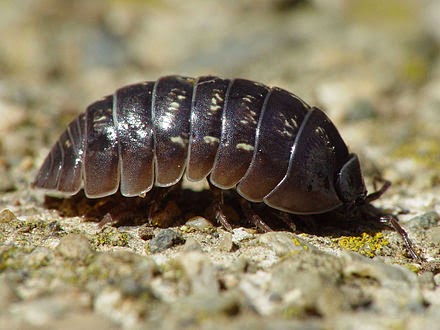 |
| http://en.wikipedia.org/wiki/Armadillidiidae |
INTRODUCTION: Before doing this experiment, it is good to know some background on
animal behavior. So what is behavior? Behavior can be defined a reaction to a
stimulus. For an animal, this is a visible activity, or simply what the animal
does (its movements), in response to an external or internal change (Dugatkin, 2012). When dealing with animal
behavior, there are two different types of questions that one can ask. They can
either ask a proximate question, or an ultimate question. A proximate question
is one that deals with the how. What
you are asking is how an internal or
external stimuli was able to trigger that animal to have a specific behavioral
reaction. An example of a proximate question would be “how does a bird know when and when not to sing”. With this question
you are searching for the environmental stimuli responsible for the behavior. An
ultimate question is one that deals with the why. It is a question that one asks when they want to know why an animal does what it does, or why
it is triggered by a certain stimuli. For example, an ultimate question that
you can ask is “why does a bird
sing”. These are the kind of questions that make you search for the
evolutionary benefit that this behavior would have for the animal.
 |
| http://sulaimansait.blogspot.com/2011/04/singing-bird.html |
Animal behavior can be categorized into
different types. One of these specific types of behavior is known as fixed action
pattern. Fixed action pattern is instinctive, meaning that it is with the
animals from the day they are born. Fixed action pattern causes all members of
a specific species to carry out the exact same sequence, without ever learning
it from their parents or other older members. Even if the action becomes
impossible to perform, the animal will still carry out the motions of that
action. For example, a dog will always know how and when to bark, even when
kept in isolation. Additionally, if a dog is physically unable to bark, it will
still go through the normal motion of barking whenever it is stimulated to.
Another example of fixed action pattern occurs in apes. It has been shown that
apes always know to be afraid of snakes. This fear even occurs when they are
raised in isolation and a fake snake, instead of a real one, is placed in front
of them.
Another type of animal behavior is
imprinting. Imprinting can be defines as a type of animal learning that only
occurs at a specific period in the animal’s life, and is generally learned very
quickly. The most common type of imprinting is called filial imprinting, in
which young birds learn to both recognize their parents and follow them around.
This occurs because baby birds form strong attachments to the first thing that
they see, which is often the mother. A proximate cause for filial imprinting in
young geese is that in their early stages of development, they see their mother
walk away from them, calling for them to follow. An ultimate cause for filial
imprinting in young geese is that following their mother gives them an
increased chance for survival, as they will receive protection from their
mother, and will learn from her the necessities for survival.
 |
| http://www.scienceclarified.com/everyday/Real-Life-Biology-Vol-3-Earth-Science-Vol-1/Instinct-and-Learning-How-it-works.html#b |
 |
| http://castlehs.com/users/johlsen/BEHAVIOUR.htm |
Interestingly, a man named Konrad Lorenz tried an experiment
where he put some geese eggs in an incubator. When the eggs hatched, Lorenz was
the first thing that the baby geese saw. As a result, they spent rest of their
lives following Lorenz around. The geese even attempted to mate with humans.
 |
| http://castlehs.com/users/johlsen/BEHAVIOUR.htm |
Two more types of animal behavior are
taxis and kinesis. In taxis, an animal moves toward or away from a stimulus. An
example would be when birds migrate towards warmer climates, and away from
colder climates. Heat is a stimulus for the birds, and that is why they move
toward it. In kinesis, the movement of the animal is completely random, and not
toward or away from the stimulus. For example, when you turn on a light,
cockroaches start jumping in all different directions. They don’t move toward
or away from the stimulus, but rather move in completely different and random
directions.
 |
| http://www.bubblews.com/news/1258321-how-do-migrating-birds-find-their-path |
 |
| http://www.fws.gov/alaska/nwr/arctic/birdworldmig.htm |
Another type of animal behavior is conditioning. The two types that I
will mention are called classical conditioning and operant conditioning.
Classical conditioning occurs when a neutral stimulus becomes associated with a
stimulus that evokes a specific response. For example, the presence of food
evokes a specific response from a dog (it thinks about food). However, if the
owner of the dog rings a bell every time that he feeds the dog, the sound of
the bell, which would normally be a neutral stimulus, will become associated
with eating food, and the dog will think about food every time that the bell is
rung. Now operant conditioning is a bit different. Operant conditioning occurs
when an animal is rewarded or punished for their behavior, or a specific
response. The animal makes an association between a behavior, and the
consequences for that behavior. For example, when you give your dog a treat
when he shakes your hand, he will associate shaking your hand with getting the
treat, and will want to shake your hand.
 |
| http://cnx.org/content/m44879/latest/?collection=col11448/latest |
 |
| http://dogrus.wordpress.com/2010/03/15/training-your-dog-to-shake-hands/ |
Now that I have introduced you to
animal behavior, and showed you a some specific types and examples of these
types, you should have no issue understanding this experiment.
QUESTION: Does the color of a rock
effect a roly-poly’s decision of whether or not to use it as shelter? Or are
roly-polies even attracted to certain colors at all?
HYPOTHESIS: If six roly-polies are placed on each side of the choice chamber, with
green rocks on one side and clear rocks on the other side, then all of the
roly-polies will end up on the side with the green rocks by the end of the
experiment, because the roly-polies will be attracted to the green color due to
the fact that their mind will connect the color green with food, such as the
plants they eat. The color of the rocks, clear and green, are the independent
variables in this experiment, and the number of roly-polies on each side is the
dependent variable. The numbers will be compared to a control, in which we
placed the roly-polies in the choice chamber with no rocks on either side.
MATERIALS:
1.
12 Roly-Polies
2.
Stock Chamber
3.
Choice Chamber
4.
Small Green Rocks
5.
Small Clear Rocks
6.
Paint Brush
7.
Cover
8.
Stopwatch
PROCEDURE:
1.
Collect 12 Roly-Polies.
2.
Add Green Rocks to one side of Choice Chamber.
3.
Add Clear Rocks to other side of Choice Chamber.
4.
Transfer Roly-Polies from Stock Chamber to Choice Chamber.
5.
Put six on each side (use paint brush to move them).
6.
Start stopwatch and cover Choice Chamber.
7.
Remove cover every 30 seconds, record new numbers, and then recover the Choice
Chamber.
8.
Continue for a total of 5 minutes.
9.
Return Roly-Polies to Stock Chamber.
10.
Put the Green and Clear Rocks back in their respected beakers.
11.
Graph data using Excel.
RESULTS:
Time (Mins)
|
Number of in Roly-Polies in Chamber with Green
Rocks
|
Number of in Roly-Polies in Chamber with Clear
Rocks
|
0
|
6
|
6
|
0.5
|
7
|
5
|
1.0
|
8
|
4
|
1.5
|
8
|
4
|
2.0
|
8
|
4
|
2.5
|
8
|
4
|
3.0
|
8
|
4
|
3.5
|
8
|
4
|
4.0
|
8
|
4
|
4.5
|
8
|
4
|
5.0
|
8
|
4
|

CONCLUSION: Our results show that the roly-polies prefer
the green rocks. This could mean that they prefer to find shelter under the
green rocks because the color reminds them of the food that they eat, such as
leaves. Since the number of roly-polies on each side did not change in our
control, in which we placed them in a choice chamber with no rocks on either
side, then our results show that their was in fact a response by the
roly-polies in our experiment. These results that we obtained fail to reject my
hypothesis that the roly-polies would be attracted to the green color of the
rocks. Animal behavior in the form of classical conditioning is taking place if
my results are accurate, because the roly-polies are associating the color green,
a neutral stimulus, with their source of food, another stimulus. For further
research, it would be ideal to set up another experiment in which we place a
green piece of paper in one side of the choice chamber, and a white piece of
paper in the other side of the choice chamber. Going back to the experiment we
just did, I would like to state two constants. First, we kept the amount of
rocks on each side fairly constant, with both sides being filled. Second, we
kept the lighting and the temperature of each side constant, so that they had
no effect on the results. Moving on, one possible source of error is that we
did not take into consideration the fact that the clear rocks were smooth and
spherical, while the green rocks were rough and shaped more like normal rocks.
The roly-polies could have just moved to the side with the green rocks because
they preferred the shape and texture of the green rocks, not the color. Another
possible source of error is that we place six roly-polies in on each side,
instead of placing all twelve in the center. By placing six on each side, it is
possible that the two roly-polies that switched sides did so randomly. If we
placed them all in the center, we would have been better able to tell if the
roly-polies preferred one side to another.
CITATION:
Dugatkin
Ph.D, Lee Alan. "What Is "Behavior" Anyway?"
Psychology Today. Sussex Publishers, LLC, 17 July 2012. Web. 14 Apr. 2014.
<http://www.psychologytoday.com/blog/the-prince-evolution/201207/what-is-
behavior-anyway>.
Quick,
Kevin, Holly Kiamanesh, Rosie Montague, Jennifer
Blanchette, and Barbara Akre. The Webb Schools Honors Biology
Textbook. Claremont: CK-12 Foundation, 2012. eBook.
“What
is Imprinting?.” wiseGEEK. Conjecture Corporation. Web.
14 Apr. 2014. < http://www.wisegeek.org/what-is-imprinting.htm>.
http://castlehs.com/users/johlsen/BEHAVIOUR.htm
http://en.wikipedia.org/wiki/Imprinting_(psychology)


