In the class before the test, we spent the majority of the class reviewing content. The greatest portion of the review was on macromolecules. In the later part of the class, we took a quiz that consisted of basic chemistry, and macromolecules (including subjects such as structural isomers). We had our quizzes graded in class, and I got a 100%.
The weekend after this class, I spent a lot of time working on my lab report, and a small amount of time on a house case write-up. I chose to due the Diffusion and Osmosis Lab, and I worked on it up until four a.m. in the morning of the night preceding the test. The end product turned out to be about 15 pages in my composition book. I think that I answered all of the questions very well, and think that I had very solid hypothesis, graphs, and conclusions. I spent only about 30 minutes studying for my test, so I hope to manage my time better for the next test.
Here is my final lab report for the Diffusion and Osmosis Lab.
Monday, September 23, 2013
Friday, September 13, 2013
Who took Jerell's iPod?
9/12/13
In the last Honors Biology class, Wednesday September 11th, we started out by showing our knowledge of macromolecules. We learned about Carbohydrates, Proteins, and Nucleic Acids for homework the previous night.
Another thing that we leaned included the synthesis and breakdown of polymers, known respectively as dehydration and hydrolysis. There were tons of other things regarding macromolecules that we learned, but it would take forever to go into detail of each one.
After the macromolecule review, we begun our Organic Compounds Lab. There were two experiments to choose from, and Brian and I chose to do the mystery lab, which was titled Who Took Jerell's iPod? What we did first was test Vegetable Oil, Glucose, Starch (either from corn or potatoes), and Powdered Eggs for Glucose, Starch, Proteins, and Lipids. The Benedict's and the Iodine test came out as expected, with the with the Benedict's(glucose tester) turning orange for the Glucose, and the Iodine(tests for starch) turning a mixture of dark blue, indigo, and black upon contact with the Starch. For the other two tests, we got some results that seemed a little obvious as well. The Bluret, which tests for Protein, came back positive for the Powdered Eggs, turning a lavender color. For the Sudan III, a lipid tester, we got positive results for the Vegetable Oil.
The two tests pictured below were used for testing Glucose and Lipid. The first test shown below is the Benedict's test, and this shows if Glucose is present. If there is Glucose present, it will turn an orange color as seen in the second picture below. The other test, image 3, is a paper bag test, which tests for the Lipids. We ended up abandoning the paper bag test however, and changed to a must faster Sudan III test, that also tested for Lipids.
The Bluret (Protein Tester) and the Sudan III (Lipid Tester) results are shown below in this picture.
Next, we did the same four tests on Pretzel crumbs, Butter, Jelly, Fat-free yogurt, and Beans. For the Benedict's test (Glucose), we got that Jelly tested positive. For the Iodine test (Starch), we got that Pretzels and Beans tested positive. For the Bluret test (Protein), we got that the Fat-Free Yogurt tested positive. And for the Sudan III test (Lipids/Fats), we got that Butter and Beans tested positive. The Buret and Sudan III tests can be seen for all five samples in the picture below.
The last two things that we tested were a dry part of Jerell's evidence, and a liquid part of Jerell's evidence. After doing all four tests, we determined that the liquid sample came back negative for everything, but the dry sample tested positive on the Iodine test, turning black. This means that there was Starch present in the dry food sample of the person who stole Jurell's iPod.
Since the Pretzel and the dry sample both tested the same in all three tests, it can be inferred that the thief was eating a Pretzel for lunch. The only person who had a Pretzel during lunch was Kiara, so it must have been Kiara who stole Jerell's iPod. Case closed.
In the last Honors Biology class, Wednesday September 11th, we started out by showing our knowledge of macromolecules. We learned about Carbohydrates, Proteins, and Nucleic Acids for homework the previous night.
![]() |
| Nice picture of cell structure. |
Another thing that we leaned included the synthesis and breakdown of polymers, known respectively as dehydration and hydrolysis. There were tons of other things regarding macromolecules that we learned, but it would take forever to go into detail of each one.
After the macromolecule review, we begun our Organic Compounds Lab. There were two experiments to choose from, and Brian and I chose to do the mystery lab, which was titled Who Took Jerell's iPod? What we did first was test Vegetable Oil, Glucose, Starch (either from corn or potatoes), and Powdered Eggs for Glucose, Starch, Proteins, and Lipids. The Benedict's and the Iodine test came out as expected, with the with the Benedict's(glucose tester) turning orange for the Glucose, and the Iodine(tests for starch) turning a mixture of dark blue, indigo, and black upon contact with the Starch. For the other two tests, we got some results that seemed a little obvious as well. The Bluret, which tests for Protein, came back positive for the Powdered Eggs, turning a lavender color. For the Sudan III, a lipid tester, we got positive results for the Vegetable Oil.
The two tests pictured below were used for testing Glucose and Lipid. The first test shown below is the Benedict's test, and this shows if Glucose is present. If there is Glucose present, it will turn an orange color as seen in the second picture below. The other test, image 3, is a paper bag test, which tests for the Lipids. We ended up abandoning the paper bag test however, and changed to a must faster Sudan III test, that also tested for Lipids.
![]() |
| Benedict's test at the start. |
![]() |
| Benedict's test after a few seconds. |
![]() |
| Abandoned paper bag test for lipids. |
The Bluret (Protein Tester) and the Sudan III (Lipid Tester) results are shown below in this picture.
![]() |
| The Bluret test positive for Powdered Eggs, the lavender bottom and third from the left The Sudan III test positive for Vegetable Oil, the bright red one in the middle left. |
Next, we did the same four tests on Pretzel crumbs, Butter, Jelly, Fat-free yogurt, and Beans. For the Benedict's test (Glucose), we got that Jelly tested positive. For the Iodine test (Starch), we got that Pretzels and Beans tested positive. For the Bluret test (Protein), we got that the Fat-Free Yogurt tested positive. And for the Sudan III test (Lipids/Fats), we got that Butter and Beans tested positive. The Buret and Sudan III tests can be seen for all five samples in the picture below.
The last two things that we tested were a dry part of Jerell's evidence, and a liquid part of Jerell's evidence. After doing all four tests, we determined that the liquid sample came back negative for everything, but the dry sample tested positive on the Iodine test, turning black. This means that there was Starch present in the dry food sample of the person who stole Jurell's iPod.
Since the Pretzel and the dry sample both tested the same in all three tests, it can be inferred that the thief was eating a Pretzel for lunch. The only person who had a Pretzel during lunch was Kiara, so it must have been Kiara who stole Jerell's iPod. Case closed.
Thursday, September 12, 2013
Macromolecules and House Case
9/10/13
We started Friday's class, 9/6/13, with a quiz on graphing. I did ok on this quiz, but I did mess up on the part which asked for some standardized variables, and the part that involved naming the graph. All in all, I got a 2 on the quiz, which is something I can live with.
After the quiz, Mr. Quick taught us about macromolecules. He taught us that there is a BiLayer, made up of phosphate and lipid, called Phospholipid. We learned that the lipid is Hydrophilic, likes water, and the phosphate is Hydrophobic, afraid of water. We learned that the combination of imbedded proteins and carbohydrates is called a Glycoprotein. Glycoproteins and Glycolipeds, which contains carbon, hydrogen, and oxygen, both act as functions, and can communicate by chemically talking. We also learned about how proteins act as transportation systems, and allows water to travel through. Proteins also allow other things to pass through, and can even help pull things through. Proteins can sense the things that touch them, and communicate it through to the other side to find out if it should be allowed to pass through or not.
Then we came up with all of the possible diagnosis, and began asking Mr. Quick some questions. Some notable answers were that he was unsure if he had diabetes, said that he drank alcohol on the weekends, and that he drank three gallons of water during cross country practice. All of the diagnosis are shown below.
We started Friday's class, 9/6/13, with a quiz on graphing. I did ok on this quiz, but I did mess up on the part which asked for some standardized variables, and the part that involved naming the graph. All in all, I got a 2 on the quiz, which is something I can live with.
After the quiz, Mr. Quick taught us about macromolecules. He taught us that there is a BiLayer, made up of phosphate and lipid, called Phospholipid. We learned that the lipid is Hydrophilic, likes water, and the phosphate is Hydrophobic, afraid of water. We learned that the combination of imbedded proteins and carbohydrates is called a Glycoprotein. Glycoproteins and Glycolipeds, which contains carbon, hydrogen, and oxygen, both act as functions, and can communicate by chemically talking. We also learned about how proteins act as transportation systems, and allows water to travel through. Proteins also allow other things to pass through, and can even help pull things through. Proteins can sense the things that touch them, and communicate it through to the other side to find out if it should be allowed to pass through or not.
We also review a bit of Osmosis and Diffusion, and how they can both be controlled by the selectively permeable cell membrane (security wall). We also learned that active transport needs energy, and that Facilitated Diffusion needs help, which it receives from either a channel or a carrier.
The rest of the class we did the House Case. Anthony, Calvin, and myself volunteered to be the doctors for this case. We wrote on the board the symptoms that the 18 year old high school cross-country runner had, which included headaches, vomiting, tiredness, and confusion. We put some tests that we would run on the patient, which included checking his vitals and temperature, blood tests, and brain scans. These are all shown below.
| Kidney Test not seen in picture, is off to right. |
After getting back the results from some tests, we eliminated some diagnosis in class, seen as crossed out in the above picture. The remaining ones were Dehydration, Over hydration/Hypernatremia, Heat Exhaustion/Stroke, Gastroenteritis, Sleep Deprivation, and Migraine. With only these left, and the others already eliminated during class, I got started. The results said that his Serum/Blood Na level was 125 meq/L, and I found that a normal Serum/Blood Na level is between 135-145 meq/L. I also found that a low Serum/Blood Na level, which is seen is this patient, occurs when there is an increase in water intake. The next results were the Serum Osmolality, and it said that his was decreased. I found out that a decrease in Serum Osmolality can be a result of drinking too much water. The next test was a Urinalysis, and it showed that his Specific Gravity had decreased. This is once again, this would be caused by an excess intake of fluids. The last result shows that that the patients blood pressure was slightly elevated, which can be caused by an increased amount in water intake. With the findings in all of these tests, and the fact that he admitted to drinking 3 gallons of water, it is pretty clear that the patient suffered from over hydration, otherwise known as Hypernatremia.
Friday, September 6, 2013
Diffusion & Osmosis Part 2
9/5/13
Our homework prior to our 5th class of Honors Biology was called House Case #1, in which we had to come up with 3 diagnosis for a patient. The patient in this case was an 18-year-old high school cross-country runner, and the issue is that he began vomiting and complaining about a severe headache at his cross-county practice. He also said that he was very tired and confused.
For my three diagnosis, I chose heat stroke, dehydration, and head trauma, such as a confusion. I found that the symptoms of all three of these possibilities included vomiting, headaches, tiredness, and confusion( among other symptoms). I will wait until next class to go into the details of my arguments for each of these hypothesizes.
During this class, we discussed the results of the experiments from the previous class, and drew graphs in order to find out the molarity of the four different potatoes tested.
Then we added iodine to the outside solution. Since starch is an indicator for iodine, the iodine should turn dark blue/black where starch is present, and brownish-yellow where there is no starch present. Since the outside solution turned brownish-yellow, it can be reasoned that the starch was not able to make it though the dialysis tubing.
We also tested 7ml of the starch/glucose solution in a cup with 1ml of Benedict's. Once these two were added together in the test tube, we heated it in water, so that the reaction would occur at a faster rate.
The color that the solution turned can be used to determine the amount of glucose. Since this solution turned orange, it can be determined that there is a lot of glucose in the solution.
We also did an experiment where we let three different sized "cells", one representing long hair cells, one skin cells, and the other one a plant cell.
We covered three different shaped cells in NaOH, and another three different shaped cells in KI, and measured how far they diffused after two minutes. Each cell diffused between two and three millimeters. We measured the surface areas of the three cells and recorded them. It appears that the solutions will be able to seep into the nucleus faster.
Our homework prior to our 5th class of Honors Biology was called House Case #1, in which we had to come up with 3 diagnosis for a patient. The patient in this case was an 18-year-old high school cross-country runner, and the issue is that he began vomiting and complaining about a severe headache at his cross-county practice. He also said that he was very tired and confused.
For my three diagnosis, I chose heat stroke, dehydration, and head trauma, such as a confusion. I found that the symptoms of all three of these possibilities included vomiting, headaches, tiredness, and confusion( among other symptoms). I will wait until next class to go into the details of my arguments for each of these hypothesizes.
During this class, we discussed the results of the experiments from the previous class, and drew graphs in order to find out the molarity of the four different potatoes tested.
![]() |
| Graph showing the estimated molarities of the potatoes. The % mass change was used as the y-axis, and the molarity of the six solutions was used as the x-axis. |
The point in which the lines cross the x-axis can also be seen as the point where the mass did not change. If the mass did not change, then the cell and the outside solution had the same molarity. So in essence, the point which the line crosses the x-axis will be equal to the molarity of the cell, or potato. Each above molarity was estimated through the use of the graph.
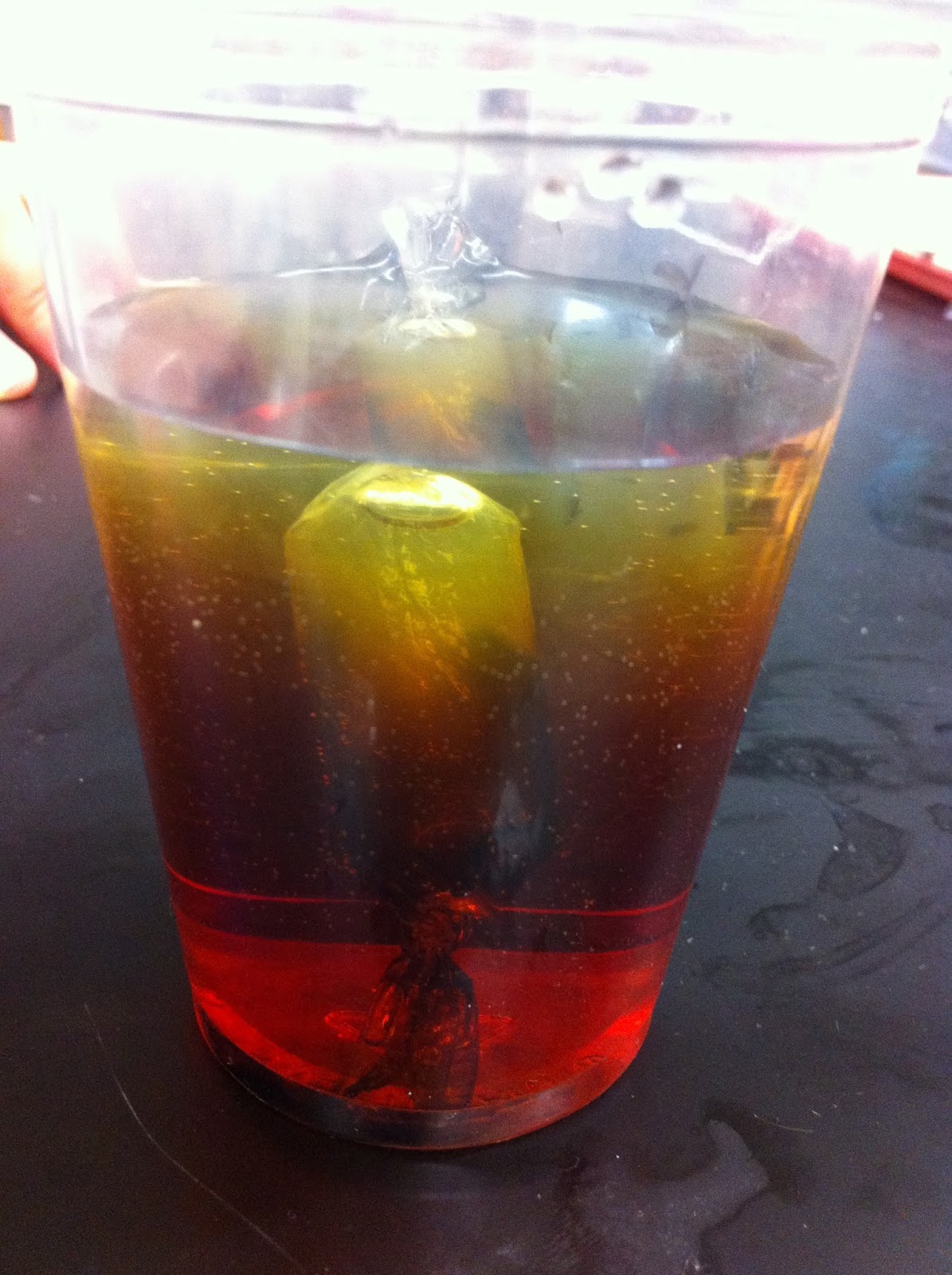
We also did an experiment where we put 7ml of a solution with a composition of 15% glucose, 5% starch, and 80% water into a dialysis tube. We then used a glucose strip to test the solution in this cell, and the strip turned brown. We also tested the water with the glucose strip, and that resulted in no color change, reassuring us that their was no glucose already in the water. Next, we placed the cell into a cup of water so that it was covered, and waited for about 15 minutes.
![]() |
| Glucose/Starch cell sitting in water. |
Then we added iodine to the outside solution. Since starch is an indicator for iodine, the iodine should turn dark blue/black where starch is present, and brownish-yellow where there is no starch present. Since the outside solution turned brownish-yellow, it can be reasoned that the starch was not able to make it though the dialysis tubing.
Since the starch was not able to pass through the dialysis tubing, the concentration of starch in the cell remained the same. And when iodine, which was able to pass through the dialysis tubing, was added to the cup, it reacted with the starch and turned dark blue/black.
![]() |
| Iodine added |
We also tested 7ml of the starch/glucose solution in a cup with 1ml of Benedict's. Once these two were added together in the test tube, we heated it in water, so that the reaction would occur at a faster rate.
The color that the solution turned can be used to determine the amount of glucose. Since this solution turned orange, it can be determined that there is a lot of glucose in the solution.
We also did an experiment where we let three different sized "cells", one representing long hair cells, one skin cells, and the other one a plant cell.
We covered three different shaped cells in NaOH, and another three different shaped cells in KI, and measured how far they diffused after two minutes. Each cell diffused between two and three millimeters. We measured the surface areas of the three cells and recorded them. It appears that the solutions will be able to seep into the nucleus faster.
Thursday, September 5, 2013
Diffusion & Osmosis
9/3/13
Prior to our 4th Honors Biology class, we were assigned to do a two things for homework.
First, we were asked to find out why red cabbage is a suitable pH indicator, how the chemistry of acids and bases affect this indicator, and explain how acid rain would affect red cabbage growth and development. The answer to the first part of this is that red cabbage contains a pigment molecule called flavin, which is an anthocyanin (an anthocyanin is known to turn red, purple, or blue depending on the pH). The answer to the second part of the question is that the colors of the pigments change color in response to changes in hydrogen ion concentration, or pH. When acids donate hydrogen ions to the solution, the hydrogen ion concentration of the solution increases. High hydrogen ion concentrations cause the pigments in the red cabbage indicator to turn red. When bases are added, the hydrogen ion concentration decreases, because the base accepts the hydrogen ions. Low hydrogen ion concentration causes the red cabbage indicator to turn greenish. A neutral hydrogen ion concentration would result in a purplish color. Finally, the answer to the last part of the question is that the red cabbage would grow and develop more slowly in acid rain, because acid rain contains less water than regular rain, making it harder to photosynthesis. Additionally, the acids would seep into the plant and dissolve some of the sugars that make up the plant. This may cause the cabbage to be weaker and break more easily.
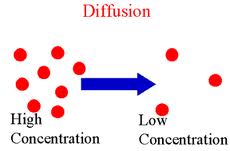
Second, we had to review 8 concepts pertaining to diffusion and osmosis. We learned that diffusion is the tendency of molecules to move from areas of higher concentration, to areas of lower concentration.
We then learned about osmosis, which is basically diffusion involving water. In osmosis however, water has to move through a selectively permeable membrane, which allows some types of molecules, and restricts others.
When a cell is involved, the movement of water is influenced by the solute concentration of the solution. If there is a higher concentration of solute in the cell than in the solution, then the water will move in, if there is smaller concentration of solute in the cell than in the solution, then the water will move out. This is the basis on which we tested our experiment.
For our in-class experimental lab, we created six cells using dialysis tubing, each about 7ml. Then we dried the cells, removing excess water weight, and massed them. Then we put each cell into a 50ml cup of water, covering the cell completely. We let them sit in the cups for 30 minutes, and then re-massed the cells and collected our data. With the exception of two cells, our data showed that the cells gained mass. This means that water moved into the cells, where the water concentration was less.
Prior to our 4th Honors Biology class, we were assigned to do a two things for homework.
First, we were asked to find out why red cabbage is a suitable pH indicator, how the chemistry of acids and bases affect this indicator, and explain how acid rain would affect red cabbage growth and development. The answer to the first part of this is that red cabbage contains a pigment molecule called flavin, which is an anthocyanin (an anthocyanin is known to turn red, purple, or blue depending on the pH). The answer to the second part of the question is that the colors of the pigments change color in response to changes in hydrogen ion concentration, or pH. When acids donate hydrogen ions to the solution, the hydrogen ion concentration of the solution increases. High hydrogen ion concentrations cause the pigments in the red cabbage indicator to turn red. When bases are added, the hydrogen ion concentration decreases, because the base accepts the hydrogen ions. Low hydrogen ion concentration causes the red cabbage indicator to turn greenish. A neutral hydrogen ion concentration would result in a purplish color. Finally, the answer to the last part of the question is that the red cabbage would grow and develop more slowly in acid rain, because acid rain contains less water than regular rain, making it harder to photosynthesis. Additionally, the acids would seep into the plant and dissolve some of the sugars that make up the plant. This may cause the cabbage to be weaker and break more easily.
Second, we had to review 8 concepts pertaining to diffusion and osmosis. We learned that diffusion is the tendency of molecules to move from areas of higher concentration, to areas of lower concentration.
We then learned about osmosis, which is basically diffusion involving water. In osmosis however, water has to move through a selectively permeable membrane, which allows some types of molecules, and restricts others.
![]() |
| Water moves from high concentration to low concentration. |
When a cell is involved, the movement of water is influenced by the solute concentration of the solution. If there is a higher concentration of solute in the cell than in the solution, then the water will move in, if there is smaller concentration of solute in the cell than in the solution, then the water will move out. This is the basis on which we tested our experiment.
For our in-class experimental lab, we created six cells using dialysis tubing, each about 7ml. Then we dried the cells, removing excess water weight, and massed them. Then we put each cell into a 50ml cup of water, covering the cell completely. We let them sit in the cups for 30 minutes, and then re-massed the cells and collected our data. With the exception of two cells, our data showed that the cells gained mass. This means that water moved into the cells, where the water concentration was less.
| A picture of the cells that we used. |
We then re-did this experiment, but put Gatorade inside of all six cells, and and covered each of these cells with 50 ml of the six different colored solutions. We weighed the dried cells before putting them in the solutions, then came back at night to weight the cells after a day of sitting in the cups. Our data showed that the % mass change for each of the cells was negative, and with the exception of one cell, the % mass change of the cells went in the same order as molarities of the solutions in the cells, with % mass changes=low molarity, and high % mass change=high molarity. This shows that the solute in the cells diffused to areas of lower concentration, which in this case was the water. With less solute remaining in the cell, the mass of the cell decreased, and that explains why the cell with the most solute lost the most mass. Since the blue cell had the least % change in mass, it can be reasoned that it had the closest molarity to the gatorade.
We also learned terms such as the following:
Hypotonic- lower solute concentration/higher water concentration
Hypertonic- higher solute concentration/lower water concentration
Water moves from Hypotonic --> Hypertonic
Isotonic- Equal in concentrations
Water Potential- Tendency of water to leave one place in favor of another.
Water moves from Higher Water Potential --> Lower Water Potential
Plasmolysis- process in plant cells where the cytoplasm pulls away from the cell wall due to loss of water through osmosis.
Cytolysis- Occurs in a hypotonic solution. The net flow of water goes into the cell
We also learned terms such as the following:
Hypotonic- lower solute concentration/higher water concentration
Hypertonic- higher solute concentration/lower water concentration
Water moves from Hypotonic --> Hypertonic
Isotonic- Equal in concentrations
Water Potential- Tendency of water to leave one place in favor of another.
Water moves from Higher Water Potential --> Lower Water Potential
Plasmolysis- process in plant cells where the cytoplasm pulls away from the cell wall due to loss of water through osmosis.
Cytolysis- Occurs in a hypotonic solution. The net flow of water goes into the cell
Sunday, September 1, 2013
Water
Blake Williams
9/1/13
During our third Honors Biology class, and for homework the prior night, we learn about all of the different properties of water. First we learned that H2O is polar, and that the reason for this is that the electrons between the oxygen and the two hydrogens atoms are not shared equally (the reason that the electrons are shared is because water is a covalent molecule). The six protons in the oxygen atom are able to pull these shared electrons with a greater force than that of the two hydrogens (for each only contains one proton).
H2O
![]() |
| H2O Water Molecule |
![]() |
| Electronegativity Charges |
![]() |
| This diagram shows that the electrons of the two hydrogens are being pulled toward the oxygen atom. This is due to the higher number of protons in oxygen than in hydrogen. |
![]() |
| The water's polarity is shown in this molecular structure. |
We found out that a water molecule is capable of hydrogen bonding with up to four other water molecules. This is because the two hydrogen atoms can bond with two oxygens from two other water molecules, and the one oxygen is capable of bonding with two hydrogen atoms from another two water molecules, adding up to four in total. The diagrams below represent this process.
![]() |
| This figure represents the attractions between two water molecules. |
![]() |
| The figure shows who one water molecule is capable of hydrogen bonding with four other water molecules. |
Cohesive
![]() |
| Hydrogen bonds hold all of the water molecule together. |
![]() |
| A paperclip behaves the same as a water strider when places on a surface of water (For our class, we use a toothpick instead). |
Adhesive
![]() |
| Water molecules are attracted to the toothpick.You can see the water move up the paperclip. |
![]() |
| Similar affect with a straw. This affect is occurs because the water molecules are polar, and therefore have a charge. This charge is attracted to the charges of the straw or other surfaces. |
![]() |
| The water molecules can be seen moving up the paper towel. this is due to both cohesion and adhesion. The water molecules are attracted to the paper towel, and also attracted to other water molecules. |
Combination
![]() |
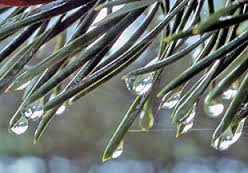
| Cohesion and adhesion often work together. In this picture, the water molecules are sticking to the leaves, and those not in direct contact to the leaves are sticking to the other water molecules. |
![]() |
| The water molecules stick to the penny, as well as to other water molecules. |
We also discussed how water affects climate and temperature fluctuation. We learned that the reason costal areas have milder climates than adjacent inland areas is because water has a high heat capacity. It requires 3200X more energy to change water by one degree than it takes to change air by one degree. This is the same reason that ocean temperatures fluctuate much less than air temperatures on land. The water in the air breaks apart, but unlike air it is able to keep reforming. Since the molecules are not being broken apart as much, the molecular motion does not increase or decrease as much as it does in air.
In class, we learned why ice floats on water. We learned that when the water is liquid, there is molecular motion, and the molecules are close together. But when the water freezes into ice, and the molecular motion stops, the water molecules form crystalline hexagon structures (because the angle between the two hydrogens and the oxygen is 120 degrees). These hexagon structures are more spread out, allowing more empty space between all of the water molecules. This extra empty space makes ice more dense than water, and that is why it floats.
Near the end of class, we talked about why human sweat and dogs pant to cool themselves. We learned that by sweating, humans release heat, because when the water is release from a human's sweat glands, it is evaporated and sent into the air (evaporation=exothermic. Therefore the heat is released from the body). Since dogs do not have sweat glands, they use the water on their tongues instead. The process results in a release in heat through evaporation as well. Mr. Quick also explained to use why this process is more difficult in humidity. He said that since their is already water saturated in the air, you body cannot produce sweat for it cannot be evaporated.
The last thing about water that I learned is that when it dissociates, it produces hydronium (H3O+), with a concentration of 10^-7 in pure water, and hydroxide (OH-), with a concentration of 10^-7 in pure water as well. Acids contain H3O+ and bases contain OH-.
My partner for the day was Brian Christiansen, and we worked on the problems involving why a water strider can walk on water, and why water formed a convex surface when a glass was overfilled.
Subscribe to:
Posts (Atom)